
Reprint of the December 2025 edition of the Eastham Waste Reduction & Recycling Committee’s Newsletter.
Click here to download the PDF version
The focus of this month’s edition of the Eastham Waste Reduction & Recycling Committee’s Newsletter is Textile Reuse and Recycling!
This month, Eastham Recycles is focusing on textiles—one of the fastest-growing and most overlooked parts of our waste stream. December’s issue explores how the clothes, linens, and accessories we no longer need can be refused, rethought, reduced, reused, and recycled instead of tossed away. You’ll learn where wearable items can find a second life through local organizations, what to do with worn or torn textiles under Massachusetts’ textile ban, and how the Bay State Textiles program at the Transfer Station helps keep fabric out of the trash.
We’re also sharing eye-opening facts about the impact of fast fashion, guidance on donating at the Swap Shop, updated holiday Transfer Station hours, and a look ahead to January’s focus on solid waste (trash).
Let’s close out the year by making thoughtful choices that keep textiles circulating—and out of the bin.
Topics include:
- Global Textile Recycling
- Textile Ban in MA
- Textiles at the Swap Shop
- Clothing Facts
- From the Nauset Green Club at NRHS
- Bay State Textiles
- Recycling Committee Charge Updated
- Volunteers Wanted
- Upcoming Events
REFUSE,RETHINK,REDUCE, REUSE,RECYCLE
December 2025
EASTHAM RECYCLES
Focus on the Textiles
Transfer Station Hours
- Dec 24: Close at 11:30am
- SWAP SHOP CLOSED
- Dec 25: Closed
- Jan 1: Closed
- Subject to change.
Helpful Links
- Mass Appeal
ccmassappeal.org - Thrift Cape Cod
thriftcapecod.com - Katy’s Korner lcoutreach.org/katys-
korner/ - Cape Abilities capeabilities.org
- Helpsy helpsy.com
January Focus: Trash Pop Quiz:
Solid Waste Pop Quiz:
Q: About what percentage of textiles can actually be reused or recycled?
A. 25%
B. 45%
C. 75%
D. 95%
Answer from last month’s quiz
What percentage of textiles can actually be reused or recycled?
D. 95%
For more information
Check out these resources for more information.
Contact us
The Eastham Waste Reduction & Recycling Committee is always looking for volunteers as well as members. Contact us via email at recyclingcommittee@eastham-ma.gov or the Eastham Waste Reduction & Recycling Committee page on the Eastham Town website.
Archives
- November 2025: Holidays
- October 2025: Swap Shop
- September 2025: Mixed Paper
- August 2025: Cardboard
- July 2025: Glass
- June 2025: Plastic
- May 2025: Plastic Bags
- April 2025: Metal
- March 2025: Compost
- December 2024: Holidays
- November 2024: Compost
- October 2024: Mixed Paper
- September 2024: Cardboard
- August 2024: Glass
- July 2024: Cans
- June 2024: Plastic
- May 2024: Plastic Bags
- April 2024: Compost
- March 2024: Trash
- February 2024: Clothes
- January 2024: Metal
Globally ONLY 12 – 15% of the material used for clothing ends up being recycled!
Where Can You Take Your Old Clothes?
- Good Condition?
- Take to a consignment store or attend a local swap meet like Swap for a Cause
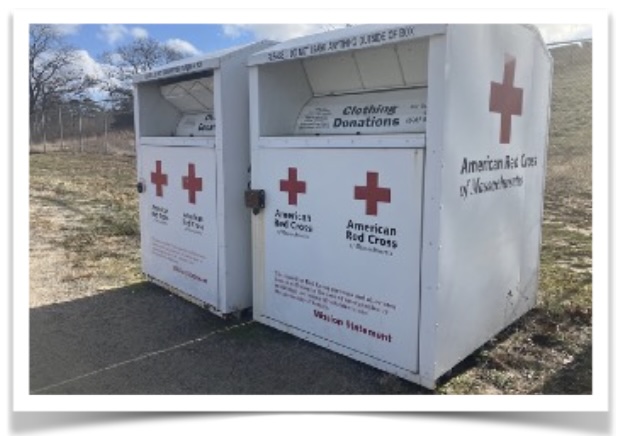
- Donate to Mass Appeal, Katy’s Korner, Nauset Green Club , the Red Cross or other local organizations
- Too used to wear?
- Place them in the Bay State Textile bins at Transfer Station by the exit.
Textile Ban in MA
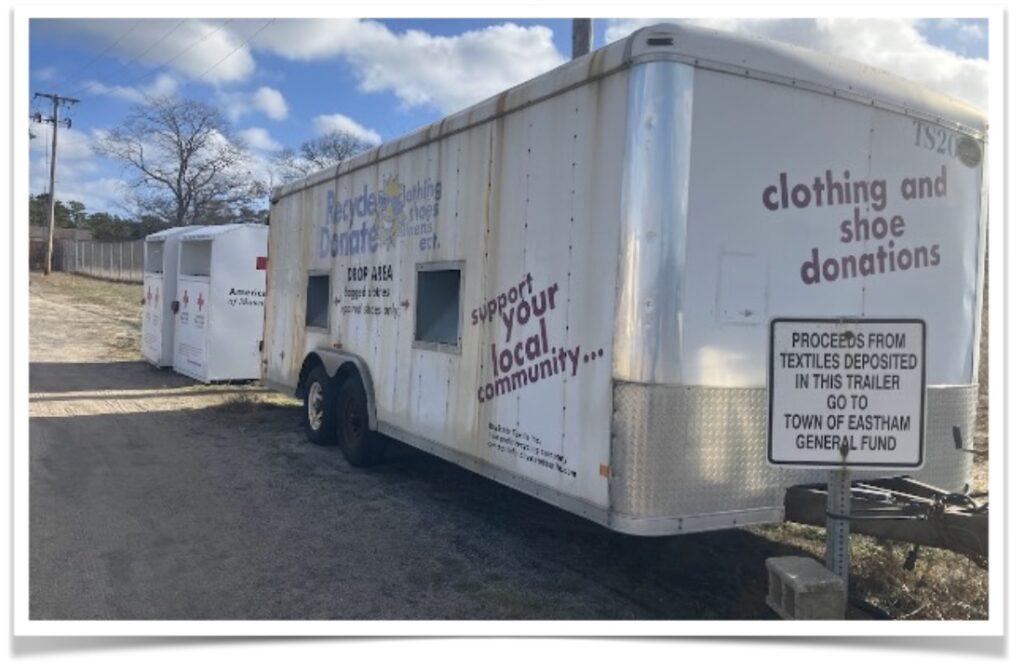
Since 2022, it’s illegal in Massachusetts to throw textiles in the trash. Textile recovery like this is one way the state aims to reduce solid waste and meet its climate goals.
Textiles at the Swap Shop
The Swap Shop is able to take clothing, table linens, and throw rugs in good shape but only if there is space and if the weather is good. If the items are not taken by the end of the day, they go in the Bay State Textile bin by the exit. If in doubt, please ask a volunteer.
Clothing Facts
Recycle Clothing Information taken from: BBC & Sustainable Business:
- Around 85% of all textiles thrown away in the US – roughly 13 million tonnes in 2017 – are either dumped into landfill or burned.
- The average American has been estimated to throw away around 37kg of clothes every year.
- By 2030, we are expected as a whole to be discarding more than 134 million tonnes of textiles a year.
- Globally the fashion industry is responsible for 10% of all greenhouse gas emissions, with textile production alone is estimated to release
- The fashion industry is responsible for 20% of global waste water.
- Synthetic clothing may take between 20 to 200 years to decompose.
From the Nauset Green Club at NRHS
Our initiative for the Nauset Green Threads is to promote recycling clothing. Textile waste is one of the leading causes of pollution in the world. Between water and energy consumption and the use of synthetic, non-biodegradable materials, fast fashion is a major problem.
At Green Threads, our goal is to make a dent in eliminating fast fashion schoolwide and to get students to understand that there are options other than online shopping. We offer an affordable alternative that consists of recycled and donated clothes we receive from the nauset community. Clean and wearable donations are encouraged and can be dropped off
at the Nauset Regional High School.
Bay State Textiles
Bay State Textiles is a regional textile recycler. They collect the bags from the bin and transport them to one of their sorting facilities.
There’s a dedicated Bay State Textiles bin right at the Eastham Transfer Station. It’s part of the MassDEP-supported “Beyond the Bin” textile recovery program.
Accepted items:
- Clothing
- Accessories
- Footwear
- Linens
- Pillows
- Plush toys—even if worn or torn, as long as clean and dry
Make sure items are clean, dry, and odor-free (no mold, stains, or contaminants). Place items neatly in bags and drop inside the bin—do not leave them outside the container.
What do textiles collected by Bay State become?
Reused (45%)
- Wearable items in good condition are resold in secondhand markets, often overseas (e.g., Latin America, Africa, Eastern Europe).
- Some are redistributed to nonprofits or thrift stores domestically.
Recycled (30%)
Unwearable textiles are cut into industrial wiping cloths (rags) used by mechanics, janitorial services, and factories. Others are processed into shoddy—a fibrous material used in:
- Insulation
- Carpet padding
- Stuffing for upholstery or pet beds
- Soundproofing materials
Waste (25%)
Items that are wet, moldy, or contaminated are not salvageable and must be landfilled or incinerated.
Recycling Committee Charge Updated
The Select Board recently approved an updated charge for the Eastham Waste Reduction & Recycling Committee (formerly the Recycling Committee). The new charge better reflects what the committee does today — promoting recycling, composting, and reuse while helping reduce overall waste at the Transfer Station.
The update also recognizes the importance of the Swap Shop and its volunteers. Together, these changes strengthen Eastham’s commitment to sustainability and community involvement.
Volunteers Wanted
The Eastham Waste Reduction & Recycling Committee is looking for new members—and community volunteers—to help strengthen our waste-reduction efforts. If you’re not ready to join the committee formally, you can still make a big difference by lending a hand on upcoming projects, including:
- Creating updated signage for the Recycling Center
- Developing a display about plastic contamination in food-waste compost
- Writing the monthly newsletter
- Assisting with a traveling compost-education workshop around town
- Working a shift at an info booth at a town event or the transfer station
- Planning future initiatives
- And more!
Whether you have an hour to spare or want to take on a small project, we’d love your help. Reach out to recyclingcommittee@eastham-ma.gov and get involved!
Upcoming Events
- Jan 20 @ 5pm: Waste Reduction & Recycling Committee Meeting (Eastham Town Hall) The agenda is available on the town website.